

New publication on LLM-supported Bayesian network modelling for clinical decision support


I am very pleased that our new paper on LLM-supported Bayesian network modelling for clinical decision supporthas now been published in the International Journal of Computer Assisted Radiology and Surgery.
This work is the result of a highly valuable collaboration between colleagues from Hahn-Schickard and the University of Freiburg in Germany, the University Hospital Leipzig in Germany, and Staten Island University Hospital / Northwell Health in New York, USA. I had the pleasure of working on this publication together with Muhammad Agus Salim, Aditya Kumar, Leonard Berliner, Andreas Dietz, Matthaeus Stoehr, and Oliver Amft.
Paper link: https://link.springer.com/content/pdf/10.1007/s11548-025-03524-9.pdf For me, this publication is an important step towards Model-Guided Medicine. Bayesian networks are highly relevant for clinical decision support because they allow medical knowledge and causal assumptions to be represented in an explicit, transparent, and interpretable way. At the same time, expert modelling of such networks is usually labor-intensive and remains one of the main barriers to wider clinical use.
In this paper, we show how large language models combined with retrieval-augmented generation (RAG) can support experts in constructing Bayesian networks more efficiently while preserving expert control and interpretability. Rather than replacing clinicians or knowledge engineers, the goal is to provide structured assistance for expert-driven knowledge modelling.
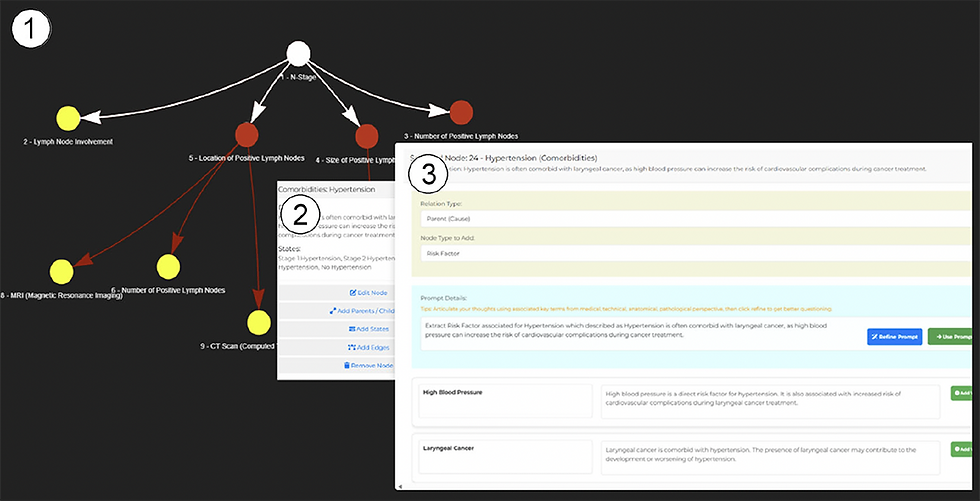
The study also produced several encouraging quantitative findings. In our evaluation, all four clinicians were able to create comprehensive Bayesian network models within one hour. The best retrieval performance was achieved with a fine-tuned GTE-Large embedding model using recursive chunking, reaching a retrieval accuracy score of 0.9. Query expansion and HyDE-based optimisation further improved retrieval quality for semantic chunking from 0.75 to 0.85, while generated responses maintained high faithfulness scores of at least 0.9. In addition, the system was described as intuitive and associated with a low cognitive workload.
What matters most to me is that this work does not argue for opaque AI-generated medical knowledge. On the contrary, it explores how generative AI can be used in a way that remains connected to transparent knowledge structures, curated biomedical sources, predefined causal modelling principles, and human oversight. In this sense, the publication reflects a line of work that I consider central for trustworthy clinical AI: not merely generating outputs, but supporting the creation of inspectable and clinically meaningful models.
At the same time, this paper is only one step. Over the past year, we have already taken several further steps towards greater transparency, traceability, and usability of such systems. These developments include stronger modelling guidance, better ways to constrain and validate AI-generated suggestions, and improvements of the user interface. Some of these next steps are already in preparation for upcoming publications.
For me, this is exactly the direction in which clinical AI should evolve: toward systems that are not only more efficient, but also more understandable, reviewable, and usable in real medical contexts. I see this work as part of a broader effort to bridge generative AI, explicit knowledge modelling, and Model-Guided Medicine in a way that supports both innovation and trust.


Comments